
Kilobyte Health
Starting Point, Goals & Outcomes
Starting Point
Home care in Germany is still largely analog. Documentation runs on paper or legacy desktop software. Coordination happens by phone, across fragmented tool stacks, and on the shoulders of a few key people — typically the care service director. At the same time, the sector is under historic pressure: rising cost, growing demand, a chronic staff shortage, and ever less time for what actually matters — the patient. Yet, home care operations are not limited by staff — they are limited by coordination bandwidth.
Most digitalization attempts fail because they tackle one isolated tool at a time. A scheduling product here, a billing module there. None of it ever adds up to an operating model. Providers end up buying more software while their organizations don't get any faster.
Goals
KiLoByte Health took a different route. Together with a German home care provider as co-creation partner, they set out to think AI end-to-end across home care operations — not as features bolted onto existing tools, but as the orchestration layer that connects them.
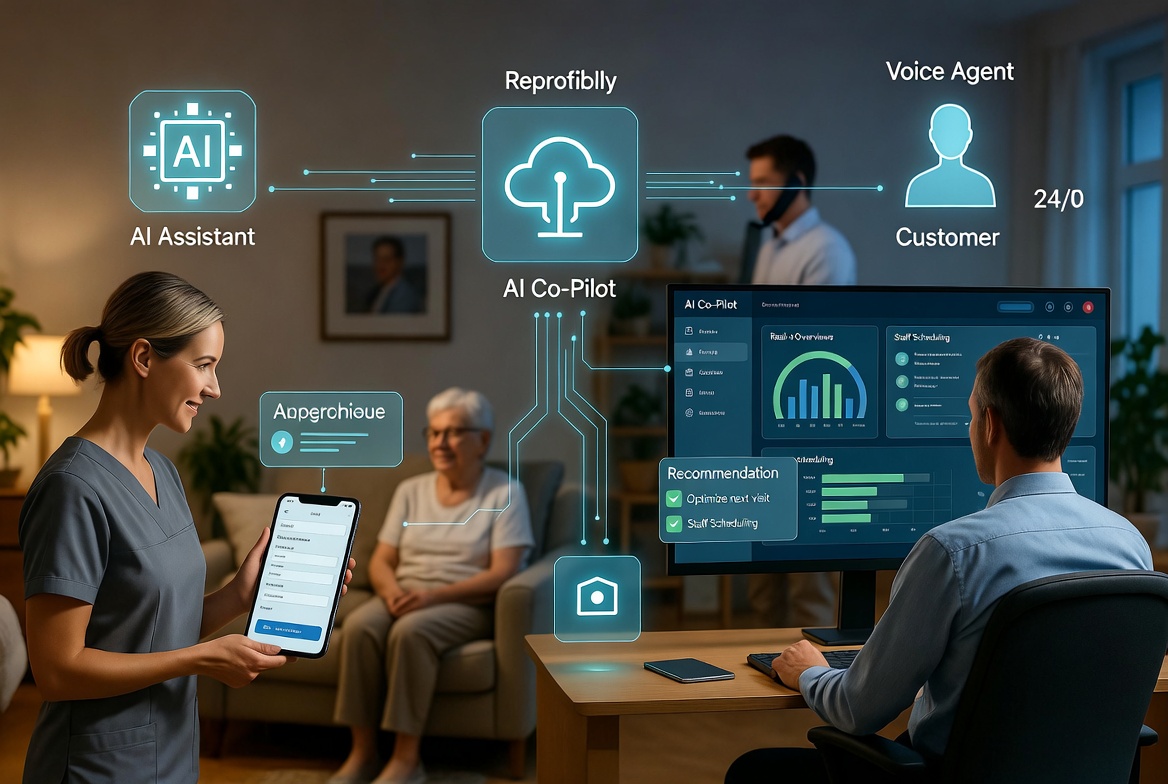
The design rests on one shared infrastructure feeding three role-specific interfaces:
A mobile app for nurses in the field, built to remove documentation friction at the point of care
A web-based AI co-pilot for care service directors, turning operational data into daily decisions
A voice agent for customers and prospects, available around the clock
The objective: relieve professional staff, keep clinical quality high, and give the operator a real-time view of the business — on a single, reusable infrastructure.
Outcomes
Between May 2025 and May 2026, the home care provider became one of the first productively running AI-native home care operations in Germany. Each layer of the architecture was designed from day one as a reusable component — and those components are now the foundation of a portable product.
70%
AI agent interaction on routed customer calls
~50%
Documentation time saved on intake & follow-up
1
Shared infrastructure powering every interface
~3%
Margin improvement through AI-driven analysis & optimization

Tobias (CTO, Kilobyte Health)

Approach
Build with the operator, not for them - KiLoByte Health took on operational accountability inside the provider — not as an external advisor, but as a co-creation partner with skin in the game. Every architectural choice had to work in live operations from day one.
One infrastructure, three interfaces - A single replicated data foundation powers the nurse app, the care director co-pilot, and the customer voice agent. Adding a new interface does not mean adding a new stack.
From co-creation to product - What worked at the provider became the basis for portable assets.

The TalentFormation Factor_
TFN partnered with KiLoByte Health during the architecture phase, providing a senior sparring layer that allowed KiloByte Health to think the model through end-to-end while operating it in real time. The combination of operator practice and external methodology was central to turning a single operator case into a portable operating model.